Most paint damage does not happen in one dramatic moment. It builds up a stone chip on the bumper in February, a scratch behind the door handle in spring, a dull patch on the rocker panel after a winter of salted roads. By the time it becomes obvious, the repair is no longer cheap.
That is why knowing the best areas to apply paint protection film matters more than simply deciding whether to get PPF at all. Some panels take almost all of the abuse, while others stay untouched for years. Protecting the right sections first gives you the strongest result for what you spend.
This guide breaks down every high-impact area on your vehicle, how coverage packages compare, and how to match protection to the way you actually drive.
What Paint Protection Film Actually Protects Against
Paint protection film is a clear, self-healing urethane layer applied directly over your vehicle’s painted surfaces. It works as a physical barrier, absorbing impact from stone chips, gravel, road salt, bug acid and everyday contact before any of it reaches your paint.
This is where PPF differs from other protection. Wax and sealants sit on top of the clear coat as a thin sacrificial layer. Ceramic coating bonds chemically and adds gloss, chemical resistance and easier cleaning but it will not stop a rock travelling at highway speed. Film has real thickness, so it takes the hit instead of your paint.
Many owners run both: film on impact zones, ceramic coating over the rest of the body for slickness and shine.
Why Some Panels Get Damaged Before Others
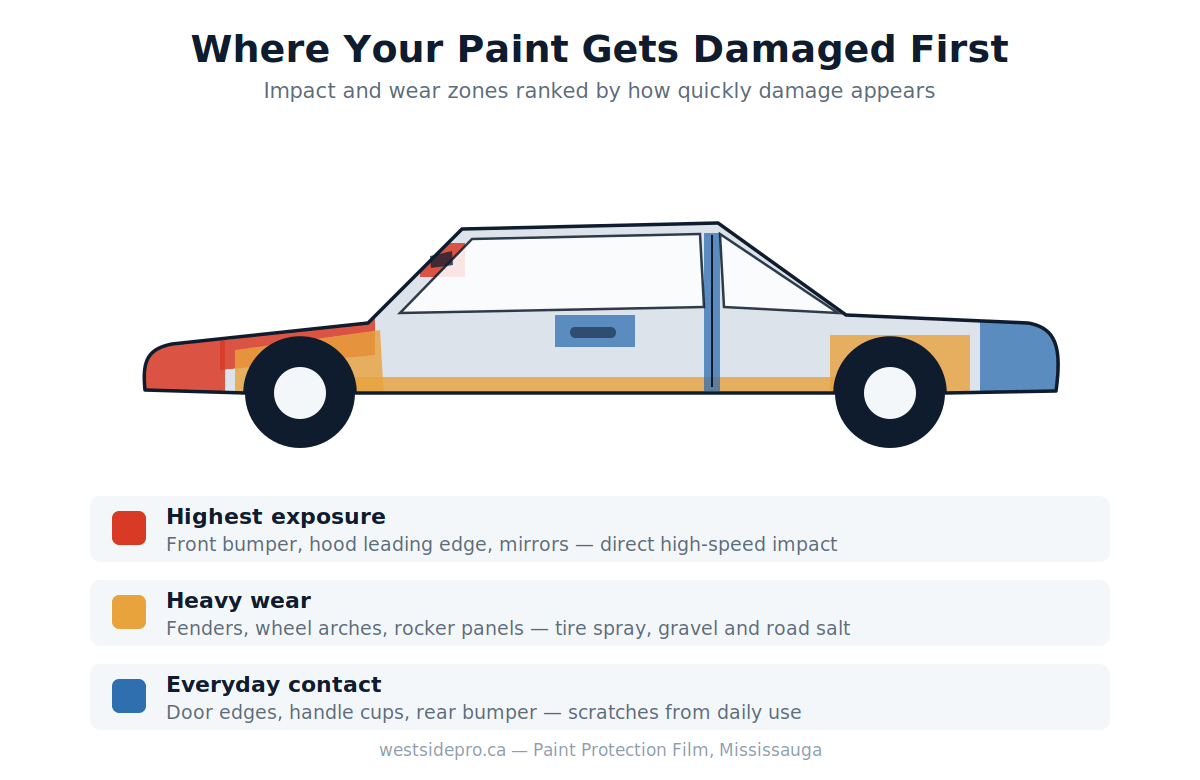
Damage follows airflow and tire spray. Anything at the front of the vehicle meets debris head-on, and anything near a wheel gets sandblasted from below. Panels you touch daily wear down in a different way through fingernails, keys and rings rather than road debris.
Understanding this pattern is the whole basis of smart coverage planning.
Damage source | Panels affected first |
|---|---|
High-speed stone and gravel impact | Front bumper, hood front edge, mirrors |
Tire spray and road grit | Fenders, wheel arches, rocker panels |
Road salt and slush | Rocker panels, lower doors, rear arches |
Daily hand contact | Door handle cups, door edges, trunk edge |
UV and environmental exposure | Hood, roof, headlights |
Best Areas on Your Car to Apply Paint Protection Film
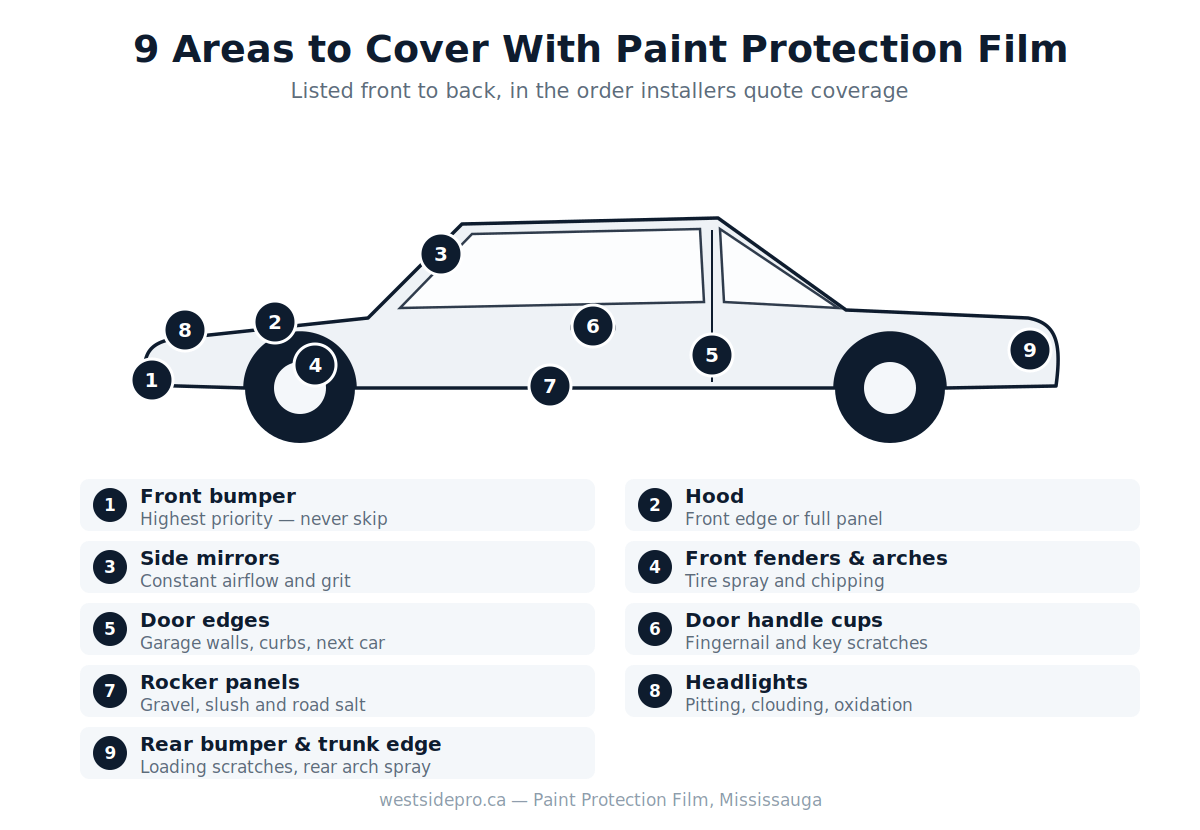
The sections below are listed front to back in the same order most installers use when quoting coverage. The higher an area sits on this list, the harder it is to justify skipping it.
Front Bumper The Single Highest Priority
If you protect only one panel, make it this one. The front bumper meets everything the road throws forward: gravel, stones, insects, salt spray and grit lifted by the vehicle ahead of you.
Even careful drivers see chips appear here first, usually within the first two winters. Bumper paint is also expensive to correct properly, because a repaint rarely matches surrounding panels perfectly and can affect resale value later.
Film here absorbs those small impacts and, with self-healing top coats, lets light swirls disappear with heat.
Takeaway: no PPF plan should ever exclude the front bumper.
Hood Front Edge or Full Coverage
The hood is the second-largest impact zone, and damage concentrates along the front 18 to 24 inches where airflow drives debris upward into the panel.
You have two realistic options. Partial coverage protects the leading edge at a lower cost, but leaves a faint film line across the hood. Full hood coverage costs more and removes that line entirely, while also protecting against bug acid, bird droppings and UV fading across the whole panel.
Takeaway: partial coverage is fine for older or budget builds; on a new or dark-coloured vehicle, full hood coverage looks noticeably cleaner.
Side Mirrors and Mirror Caps
Mirrors are small, but they sit outside the body line and directly in the airflow, so they collect grit and stone strikes constantly. They also get scraped in tight parking garages and drive-throughs.
Damage here is very visible because mirrors sit at eye level, and replacement caps on modern vehicles are surprisingly expensive once you factor in painted finishes, heating elements and blind-spot sensors.
Takeaway: mirrors add very little to the cost of a package and are almost always worth including.
Front Fenders and Wheel Arches
The fenders sit right behind the front wheels, which means they take continuous spray of sand, gravel and salted slush thrown up by the tires. The leading edge and the arch lip wear fastest.
Chipping here spreads. Once the clear coat is broken along an arch, moisture works underneath and edges begin to lift or corrode, particularly through Ontario winters.
Takeaway: at minimum, protect the partial fender section included in full front packages; full fenders if you drive year-round.
Door Edges
Most door edge damage is self-inflicted and completely avoidable garage walls, curbs, parking pillars and the car in the next stall. A single contact can chip paint straight down to the primer.
Because the damage sits on a thin, exposed edge, it is one of the hardest spots to repair invisibly and one of the first things a buyer notices when inspecting a used vehicle.
Takeaway: door edge strips are inexpensive, take minutes to install and prevent a disproportionate amount of long-term damage.
Door Handle Cups
The recessed area behind each handle takes constant contact from fingernails, rings and keys. The result is a halo of fine scratches that becomes glaringly obvious on black, dark grey and deep blue paint.
This is wear, not impact, so it appears gradually and most owners only notice it under direct sunlight by which point it has been building for a year or more.
Takeaway: handle cup film is one of the cheapest additions in any package and one of the most visible improvements over time.
Rocker Panels and Lower Side Panels
Rocker panels run along the bottom of the doors and absorb everything the tires kick sideways: gravel, mud, water and salt. They are also the most commonly skipped area, because damage sits below eye level until it is severe.
For anyone commuting on the 401, 403 or QEW through winter, this is a genuinely high-value area. Salt exposure combined with chipping accelerates corrosion along the lower body seams.
Takeaway: add rocker panels if you drive highways daily or keep vehicles long term.
Headlights and Fog Lights
Modern headlight assemblies are polycarbonate, not glass, and they cloud over time through UV exposure, pitting and micro-abrasion. Replacement on an LED or adaptive unit can run into four figures.
Film keeps the lens surface clear, reduces oxidation and blocks the small stone strikes that leave permanent pitting. Clear headlights also keep the front of the vehicle looking current rather than aged.
Takeaway: headlight film is protective and functional cloudy lenses reduce actual light output at night.
Rear Bumper, Trunk Edge and Rear Wheel Arches
The rear of the vehicle takes a different kind of damage. The trunk edge and rear bumper top get scratched by luggage, grocery bags, tools and sports gear during loading. Rear arches collect debris spray in the same way the front ones do.
None of this is dramatic, but it accumulates in exactly the area a buyer inspects closely.
Takeaway: loading strips on the bumper and trunk edge are a small, high-return addition for daily drivers, SUVs and work vehicles.
PPF Coverage Packages: Partial Front vs Full Front vs Full Body
Coverage is usually sold in packages rather than panel by panel. Understanding what each one includes makes it much easier to compare quotes.
Package | Typically includes | Best for | Trade-off |
|---|---|---|---|
Partial front | Bumper, partial hood, partial fenders, mirrors | Budget-conscious owners, older vehicles | Visible film lines on hood and fenders |
Full front | Full bumper, full hood, full fenders, mirrors, headlights | Highway commuters, most daily drivers | Rear and lower panels remain unprotected |
Full body | Every painted exterior panel | Luxury, performance, new and long-term-ownership vehicles | Highest upfront cost |
Full front is the most popular choice because it covers the areas responsible for the large majority of visible paint damage. Full body makes the most sense when resale value is a priority, the paint is soft or exotic, or you plan to keep the vehicle for many years.
If you are unsure which package fits your vehicle, book a free consultation and get a panel-by-panel recommendation instead of a generic quote.
How to Choose PPF Coverage Based on How You Drive
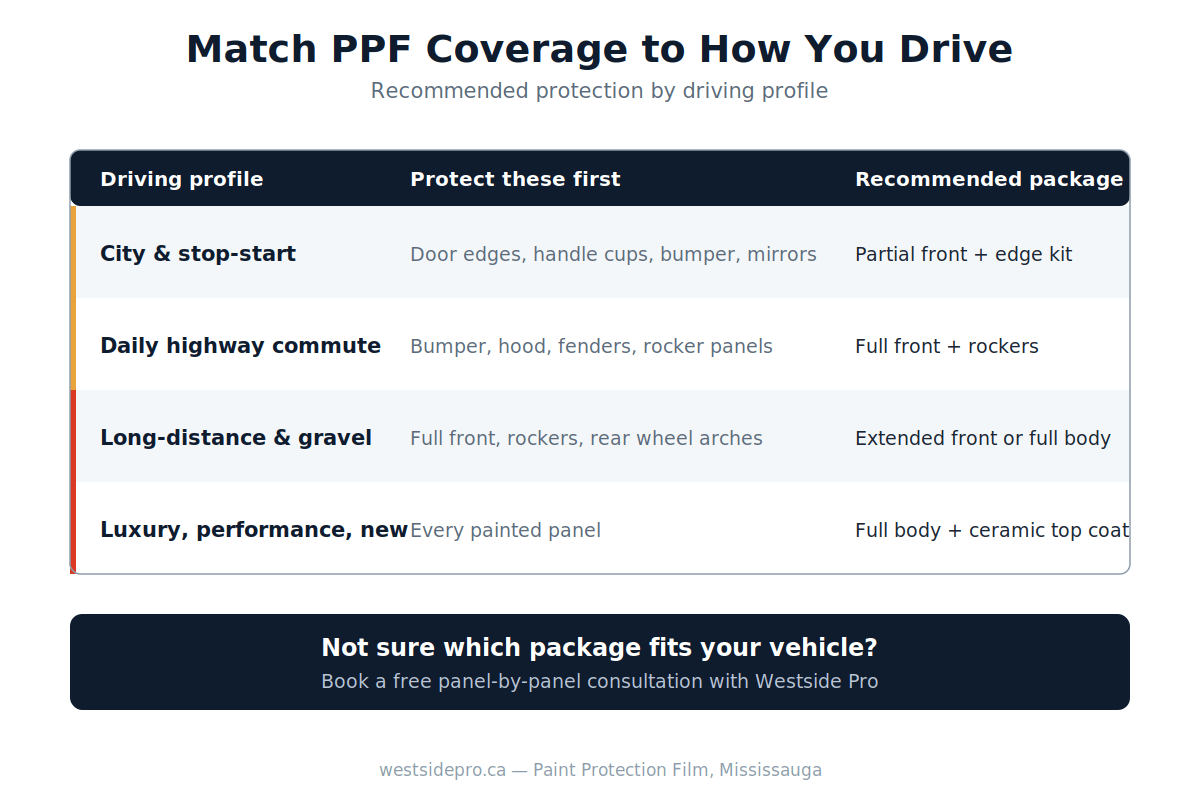
Two identical vehicles can need very different coverage. Match protection to your actual routine.
City and Stop-Start Driving
Low speeds mean less stone impact but far more contact damage. Prioritise door edges, handle cups, the front bumper and mirrors the panels that suffer in tight parking, drive-throughs and underground garages.
Daily Highway Commuting
Speed multiplies impact energy. The hood front edge, bumper and fenders take heavy abuse, and winter salt makes rocker panels a real concern. Full front coverage plus rocker panels is the practical baseline here.
Long-Distance and Rough-Road Driving
Gravel shoulders, construction zones and unpaved access roads accelerate every type of damage at once. Full front coverage, rocker panels and rear arches are worth the investment, and full body is reasonable for anyone covering serious annual distance.
Luxury, Performance and Brand-New Vehicles
Soft factory paint, wide panels and low front splitters all chip easily, and correction on premium finishes is expensive. Full body coverage protects resale value and keeps the finish flawless. Pairing film with ceramic coating adds gloss and makes maintenance washing much easier.
Mistakes That Waste Your PPF Budget
- Skipping the front bumper to save money. It is the panel most likely to be damaged, so cutting it removes most of the value.
- Choosing partial coverage without seeing the film line. Ask the installer to show you exactly where the edge will sit before committing.
- Judging quotes on price alone. Poor installation shows up as lifted edges, trapped dust and visible seams within months.
- Applying film over damaged paint. Chips and swirls need correction first, otherwise you seal the damage under the film.
- Waiting until chips appear. PPF prevents damage; it cannot reverse it. The best time to install is on a new or freshly corrected finish.
- Ignoring aftercare. Film needs the right washing routine to stay clear and bonded at the edges.
How to Maintain PPF After Installation
- Wait roughly seven days before the first wash so the edges fully cure.
- Hand wash with a pH-neutral shampoo and two buckets; skip brush-style automatic washes.
- Keep pressure washers at a distance and never aim directly at film edges.
- Remove bug residue and bird droppings quickly acids can stain the film surface.
- Apply a film-safe sealant or ceramic top coat to maintain gloss and make cleaning easier.
Get Professional PPF Coverage at Westside Pro
Westside Pro provides precision paint protection film installation in Mississauga with computer-cut patterns, wrapped edges where possible and premium self-healing film. We assess your vehicle, your paint condition and your driving conditions before recommending coverage so you are protecting the panels that actually need it.
Contact our team to discuss the right PPF package for your vehicle.
Frequently Asked Questions
Which areas of a car should have paint protection film applied?
The front bumper, hood, front fenders, side mirrors and headlights are the highest priority, since they absorb the majority of road debris impact. Rocker panels, door edges and handle cups are strong additions for daily drivers.
Which part of the car gets damaged the most?
The front bumper. It meets stones, gravel, insects and salt spray head-on at speed, which is why chips almost always appear there before anywhere else on the vehicle.
Is partial PPF enough for daily driving?
For most drivers, yes. Full front coverage protects the panels responsible for the majority of visible paint damage. Full body coverage is worth considering for luxury, performance or long-term-ownership vehicles.
Does PPF stop rock chips completely?
It stops the vast majority. The film absorbs and disperses impact from typical gravel and stone strikes, though a large rock at high speed can still cause damage.
Can PPF be installed on headlights?
Yes. Headlight film protects against pitting, oxidation and clouding, which helps maintain both appearance and actual light output over the life of the vehicle.
Will PPF change how my car looks?
Quality film is virtually invisible once installed and preserves the original gloss. Matte film is also available if you want to change a glossy finish to satin.
How long does paint protection film last?
Professionally installed premium film typically lasts five to ten years, depending on film quality, driving conditions and how well it is maintained.
Can I apply ceramic coating over PPF?
Yes, and many owners do. A film-safe ceramic coating adds gloss, improves water behaviour and makes the film surface easier to clean.