Window tinting laws in Ontario are built around visibility, not a fixed percentage. The Highway Traffic Act does not name a legal tint number it prohibits any film on the windshield or front side windows that substantially obscures the interior of your vehicle. In practice, front side windows are expected to stay above 70% Visible Light Transmission (VLT), aftermarket windshield film is not permitted, and rear windows can be tinted as dark as you like.
That gap between what the law says and what enforcement looks like is where most drivers get caught. Two cars with identical film can be treated differently depending on the officer, the lighting, and whether a tint meter comes out. Here is exactly what applies to your vehicle, what it costs if you get it wrong, and how to choose a tint that will not cause you problems.
What Ontario Law Actually Says About Window Tint
Most tint articles open with a chart of legal percentages. Ontario does not have one. Understanding why changes how you should approach the decision.
Section 73(2) and 73(3) of the Highway Traffic Act
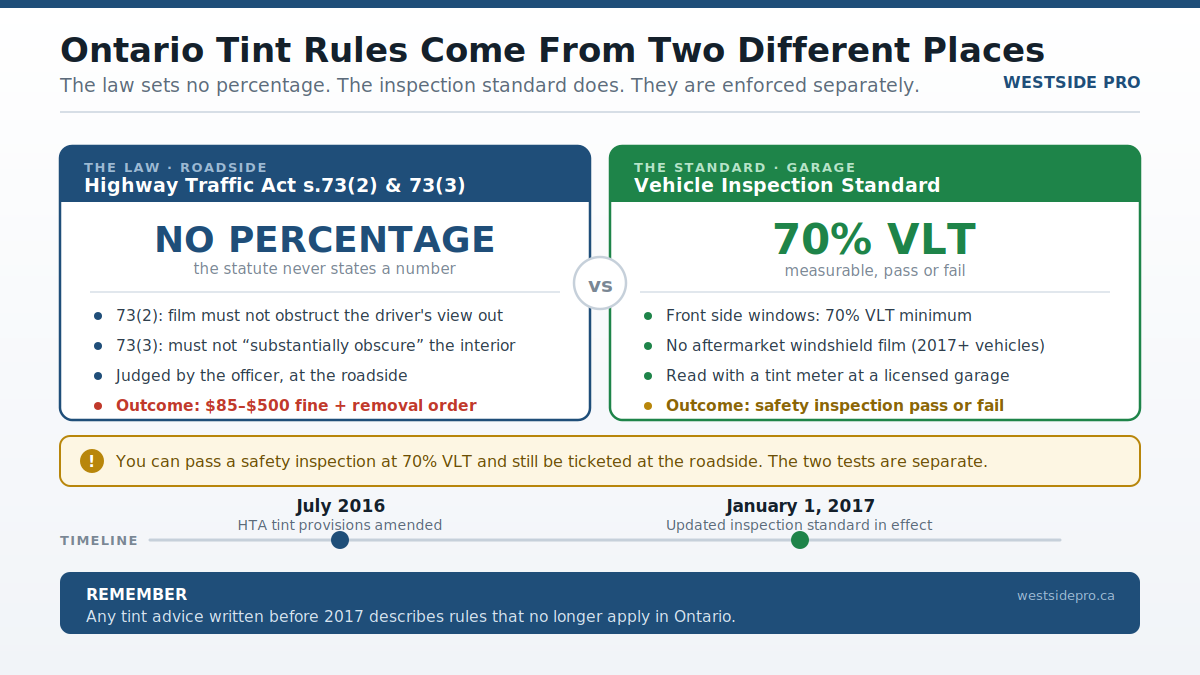
Two subsections of the Highway Traffic Act govern window tint in Ontario.
Section 73(2) prohibits driving a vehicle where the windshield or any window has been coated in a way that obstructs the driver’s view of the road or an intersecting road. It is about what you can see out of.
Section 73(3) is narrower and more relevant to tint. It prohibits driving a vehicle where the windshield, or any window directly to the left or right of the driver’s seat, has been coated with coloured or reflective material that substantially obscures the interior of the vehicle when viewed from outside. It is about what a police officer can see into.
Neither subsection contains a number. The word doing all the work is “substantially,” and interpreting it is left to the officer at the roadside.
Where the 70% VLT Rule Actually Comes From
The 70% figure you see everywhere is real, but it does not come from the Highway Traffic Act. It comes from Ontario’s Passenger and Light-Duty Vehicle Inspection Standard, which is the checklist used during a safety inspection.
Visible Light Transmission is simply the share of light that passes through the glass and film combined. A 70% VLT window lets 70% of light through and blocks 30%.
This distinction matters more than it sounds:
- A vehicle can pass a safety inspection at 70% VLT and still be ticketed at the roadside if an officer decides the interior is substantially obscured.
- A vehicle can also be ticketed for reflective film that meets the VLT threshold, because reflectivity is treated separately from darkness.
Ontario amended the tint provisions of the Highway Traffic Act in July 2016, and the updated inspection standard took effect on January 1, 2017. Anything you read that predates 2017 including a lot of forum advice is describing rules that no longer apply.
Ontario Window Tint Limits at a Glance
| Window | Legal position in Ontario |
|---|---|
| Windshield | No aftermarket tint. Factory tint only, 70% VLT, within 75 mm of the top edge |
| Front side windows | Expected to stay at or above 70% VLT; must not substantially obscure the interior |
| Rear side windows | Any darkness permitted, including 5% limo tint |
| Rear windshield | Any darkness permitted, provided both external side mirrors work |
| Reflective or mirrored film | Not permitted on any window |
Two things this table does not show: factory glass is often already tinted, so your starting VLT may be below 100% before any film goes on. And Ontario has no tint certificate, sticker, or exemption system compliance is the driver’s responsibility, not the installer’s.
Legal Tint Rules for Each Window
Front Side Windows (Driver and Passenger)
Front side windows are the most heavily regulated and the most common source of tickets. The inspection benchmark is 70% VLT, and anything meaningfully darker risks being read as substantially obscuring the interior.
- Aftermarket tint on front side windows is not expressly authorised by the Act it is tolerated, not permitted.
- Factory glass already carries some tint, so adding film can push combined VLT below 70% even when the film itself is very light.
- An officer can issue a ticket based on visual assessment alone, before any meter is used.
Because the standard is discretionary rather than numerical, many installers recommend leaving front side windows untinted, or using a very high-VLT ceramic film that delivers heat rejection without visible darkening. If you do proceed, professional window tinting with pre-measurement is the only way to know where your combined VLT actually lands.
Windshield
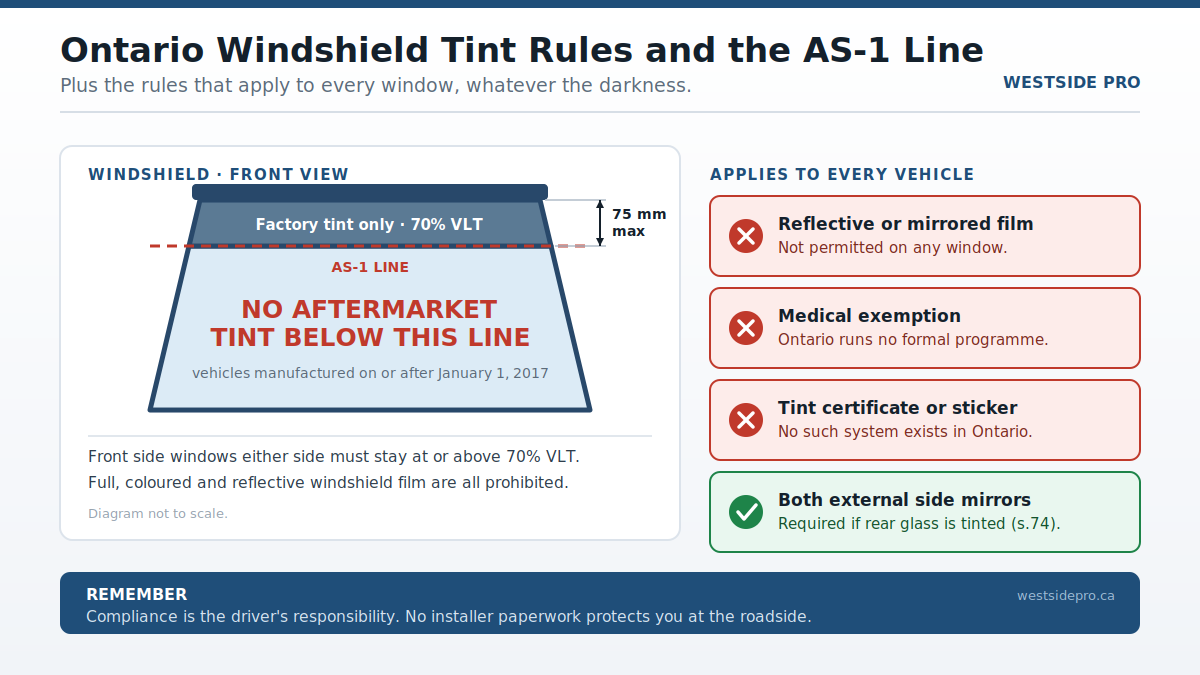
The windshield carries the strictest rule in the province. For vehicles manufactured on or after January 1, 2017, aftermarket windshield film is not permitted at all.
The only tint allowed is factory-installed, and it must:
- Allow at least 70% VLT
- Extend no more than 75 mm down from the top edge of the windshield, at the AS-1 line
Full windshield film, coloured film, reflective film, and aftermarket brow strips are all outside the rules. Even a light aftermarket film across the windshield is enough to fail a safety inspection.
Rear Side Windows
Ontario places no darkness restriction on any window behind the driver. Rear side windows can be tinted to any level, including 5% limo tint.
This is where most drivers should spend their tint budget. Rear windows deliver the majority of the privacy and rear-cabin heat reduction people are actually looking for, with no legal exposure at all.
Rear Windshield
The rear windshield can also be tinted to any darkness. The one condition, set out in Section 74, is that the vehicle must have functioning external rearview mirrors on both the left and right side.
If a side mirror is missing, cracked to the point of being unusable, or has been removed, dark rear glass becomes a compliance problem not because of the tint itself, but because rear visibility is no longer covered.
Reflective, Mirrored and Coloured Films
A few rules apply across the whole vehicle regardless of window position:
- Reflective and mirrored films are prohibited. Reflectivity is assessed separately from VLT, so a light mirrored film is still non-compliant.
- Ontario does not recognise formal medical exemptions for darker tints.
- There is no tint certification, sticker, or registration system in the province.
The practical takeaway: no document you receive from an installer protects you at the roadside.
Tint Percentages Explained: What the Numbers Mean
How the Percentage Scale Works
Tint percentage describes how much light passes through, not how much is blocked. The scale runs backwards from what most people assume a lower number means darker glass.
A 5% tint lets 5% of light through and is nearly opaque from the outside. A 70% tint lets 70% through and is barely visible as tint at all. When film is applied over factory-tinted glass, the two multiply, so a 70% film on 80% factory glass produces roughly 56% combined VLT.
Popular Tint Percentages and Where They Are Legal in Ontario
| Tint % | Look and feel | Ontario legality |
|---|---|---|
| 5% (limo) | Near-total privacy, heavy night-visibility reduction | Rear windows only |
| 15% | Very dark, bold appearance, strong UV block | Rear windows only |
| 20% | Dark with usable outward visibility | Rear windows only |
| 35% | Popular balance of heat, glare and light | Rear windows only illegal on front side windows |
| 50% | Light shade, noticeable glare reduction | Rear windows; too dark for front side glass on most vehicles |
| 70% | Subtle, near-clear finish | The working benchmark for front side windows |
Choosing a Percentage Based on Your Goal
If you want maximum privacy: go dark behind the driver. 5% to 20% on rear side windows and the rear windshield gives you full cabin privacy with no legal exposure, and leaves your front glass compliant.
If you want heat and UV rejection: darkness is not the variable that matters. A quality ceramic film at 70% VLT can reject more infrared heat than a cheap dyed film at 20%, while staying legal on every window of the car. Ask for infrared rejection and total solar energy rejected figures, not just the shade.
If you drive a lot at night: keep front side windows at 70% and avoid going below 35% anywhere you rely on for shoulder checks and reversing. Cameras and sensors help, but they do not replace direct visibility in rain or unlit conditions.
How Window Tint Affects Ontario Safety Inspections
Window tint is checked during safety inspections, and it is one of the more common single-item failures. For vehicles manufactured on or after January 1, 2017, an inspection will flag:
- Any aftermarket film on the windshield, at any darkness
- Front side windows measuring below 70% VLT
- Reflective or mirrored film on any regulated window
- Missing or non-functional external side mirrors where rear glass is tinted
A failure is not just an inconvenience. You will typically need to strip the film, pay for removal, and re-book the inspection and if the inspection is tied to a used vehicle purchase or an ownership transfer, the transaction stalls until it clears.
Fines and Penalties for Illegal Window Tint in Ontario
Non-compliant tint in Ontario generally carries a fine in the range of $85 to $500, plus court and victim fine surcharges. Beyond the fine, you may face:
- An order to remove the film before the vehicle is driven again
- Removal and re-tinting costs, often exceeding the original installation price
- A failed safety inspection and delayed registration or ownership transfer
- A repeat stop, since the film is still visible until you remove it
Because the roadside standard is discretionary, the cost of being marginally too dark is unpredictable. Staying clearly inside the guidance is the cheapest position to be in.
Legal Myths That Get Ontario Drivers Fined
Myth: 35% Tint Is Legal on Front Windows
The truth: It is not. 35% film blocks roughly two-thirds of incoming light, which puts front side windows well below the 70% VLT benchmark. This is the single most common reason Ontario drivers get ticketed, usually because they were quoted a rule from another province or a U.S. state.
Myth: Window Tinting Is Illegal in Ontario
The truth: Tinting is legal and widely done. Only the windshield and front side windows are meaningfully restricted. Everything behind the driver can be tinted to any darkness, which is why so many vehicles on Ontario roads have very dark rear glass and clear front glass.
Myth: Factory Tint Means You Can Add More Film
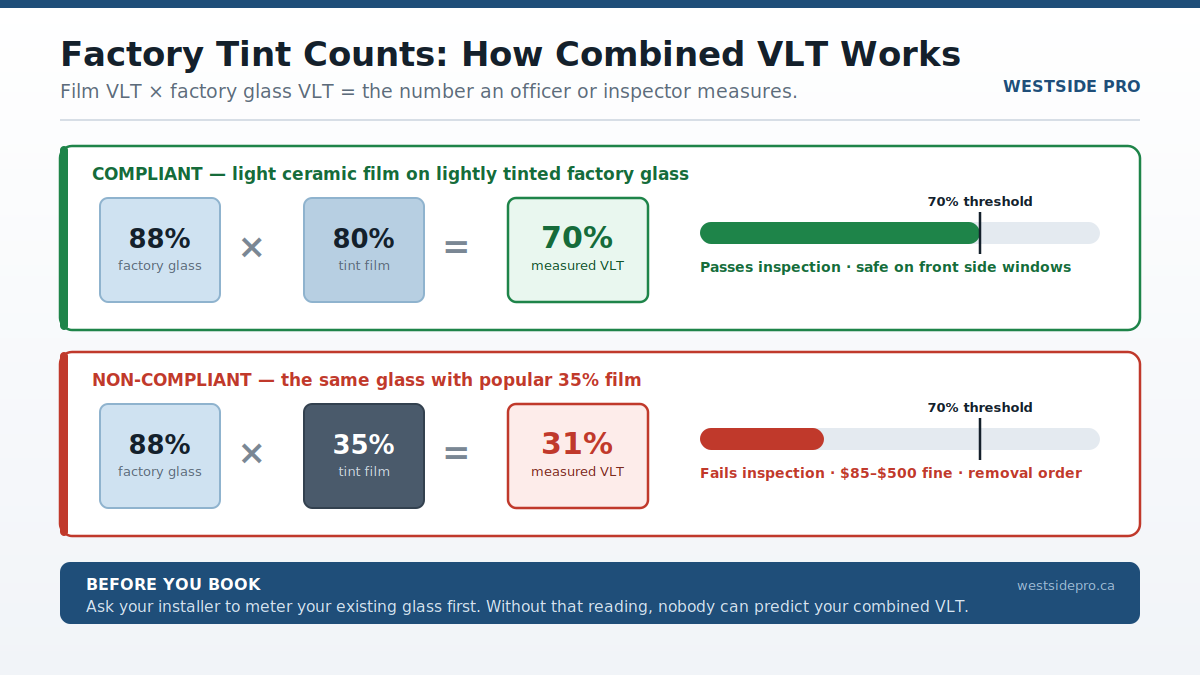
The truth: Factory tint counts toward your total. Many vehicles leave the plant with lightly tinted front glass, so adding even a high-VLT film can drop the combined reading below 70%. The only way to know is to measure the glass before installation, not after.
Myth: If It Passed Inspection Once, It Is Legal Forever
The truth: Compliance is assessed at the time of the stop, not the time of the inspection. Film degrades, discolours, and can be layered over during a later install. A car that passed two years ago can measure differently today.
Myth: Police Cannot Actually Measure Tint
The truth: Officers can and do carry handheld tint meters, which clamp over the glass and read VLT directly. A visual assessment is enough to initiate the stop; the meter is what makes the charge stick.
Myth: A Medical Condition Allows Darker Tint
The truth: Ontario does not operate a formal medical exemption programme for window tint. Documentation from a physician does not create a legal defence for front side window film that substantially obscures the interior.
Product Myths About Window Tint
Myth: Tint Is Only About Privacy and Looks
The truth: Privacy is one benefit of several. Quality film blocks up to 99% of UV radiation, cuts cabin heat build-up, reduces glare from headlights and low sun, and slows interior fading on dashboards, leather and trim.
Myth: All Window Films Are the Same
The truth: Film construction changes performance substantially. Dyed films are the cheapest and fade fastest. Metalized films reject heat well but can interfere with GPS, cellular and tyre-pressure sensor signals. Ceramic films deliver the highest infrared rejection with no signal interference, which is why they are the default recommendation for daily drivers.
Myth: Tint Makes Night Driving Dangerous
The truth: At legal levels on front glass, it does not. Quality film reduces headlight glare without meaningfully cutting usable light. Night visibility only becomes a genuine problem with very dark film on windows you rely on for shoulder checks which is exactly what Ontario’s front-window rules are designed to prevent.
Myth: Window Film Damages Your Glass
The truth: Professionally installed film does not damage glass. It adds a bonded layer that helps hold fragments together if the glass is struck, and provides light scratch resistance. Damage is almost always a symptom of poor removal technique or heat-gun misuse during a botched DIY install.
Myth: Tint Fades and Peels Within a Year
The truth: Cheap dyed film does. Quality ceramic and carbon films, professionally installed and cured properly, hold colour and adhesion for many years and are commonly sold with long-term or lifetime warranties against bubbling, purpling and delamination.
Myth: DIY Tinting Is as Good as Professional Installation
The truth: DIY installs produce bubbles, creases, lifted edges and contamination under the film far more often than not. More importantly for Ontario drivers, a DIY install skips the one step that matters legally: measuring the glass VLT before and after application.
How to Make Sure Your Tint Is Legal
Pre-Installation Checklist
- Measure your existing glass. Get a VLT reading on the front side windows before any film is discussed.
- Calculate the combined figure. Film VLT multiplied by glass VLT is your real number ask the installer to show you the math.
- Keep front side windows at or above 70% combined VLT.
- Rule out windshield film entirely if your vehicle was manufactured on or after January 1, 2017.
- Confirm the film is non-reflective. Check the spec sheet, not the sample card.
- Check both side mirrors before going dark on the rear glass.
Why Professional Installation Matters in Ontario
Because Ontario’s roadside standard is interpretive, the value of a professional installer is not just a clean finish it is documentation and measurement. A proper shop meters the glass first, tells you what your combined VLT will be, and steers you away from combinations that will fail an inspection or attract a stop.
That also means being told no sometimes. An installer who will put 20% film on your driver’s window without measuring anything is selling you a removal job.
Benefits of Staying Within Legal Tint Limits
- Cabin heat reduction on summer days, with less air conditioning load
- Up to 99% UV rejection, protecting both skin and interior surfaces
- Reduced glare from headlights, low sun and wet road surfaces
- Genuine rear-cabin privacy without any legal exposure
- A clean, finished appearance that will pass a safety inspection
Final Thoughts
Window tinting laws in Ontario reward a simple approach: keep the front of the car light, keep the back as dark as you want, and never put aftermarket film on the windshield. Because the Highway Traffic Act measures compliance by whether your interior is substantially obscured rather than by a fixed number, the safest position is to stay clearly above the 70% VLT benchmark on front side windows instead of testing where the line sits.
Get the glass measured before anything is applied, choose ceramic film if heat rejection is the goal, and use an installer who knows the provincial standard. WestSide Pro handles window tinting to Ontario compliance standards across the GTA contact us for a VLT assessment and a recommendation for your specific vehicle.
Frequently Asked Questions
1. What is the legal window tint percentage in Ontario?
Ontario law does not state a percentage. The inspection standard requires front side windows to allow at least 70% Visible Light Transmission, and that figure is treated as the working legal benchmark. Rear side windows and the rear windshield have no darkness limit.
2. Is 35% tint legal in Ontario?
No, not on front side windows. 35% film falls far below the 70% VLT benchmark and is a common reason for tickets. It is completely legal on rear side windows and the rear windshield, where no darkness restriction applies.
3. Can I get fined for dark window tint in Ontario?
Yes. Fines generally range from $85 to $500 plus surcharges, and you may be ordered to remove the film. Because enforcement rests on an officer’s assessment of whether your interior is substantially obscured, marginal cases can go either way.
4. Is windshield tint allowed in Ontario?
No aftermarket windshield film is permitted on vehicles manufactured on or after January 1, 2017. Only factory-installed tint is allowed, at a minimum of 70% VLT and extending no more than 75 mm from the top edge of the windshield.
5. Does Ontario allow limo tint on rear windows?
Yes. 5% limo tint is legal on rear side windows and the rear windshield. The only requirement is that the vehicle has functioning external rearview mirrors on both sides.
6. Does factory tint count toward the legal limit?
Yes. Factory glass tint and aftermarket film combine, so the measured total is what matters. A light film applied over already-tinted factory glass can push the combined reading below 70% VLT.
7. How do police check window tint in Ontario?
Officers typically start with a visual assessment during a stop. If the tint appears to obscure the interior, they can use a handheld tint meter that clamps over the glass and reads Visible Light Transmission directly.
8. Can tinted windows cause a safety inspection failure in Ontario?
Yes. Vehicles manufactured on or after January 1, 2017 fail if aftermarket windshield film is present or if front side windows measure below 70% VLT. Reflective film and non-functioning side mirrors also trigger failures.
9. Does Ontario offer a medical exemption for darker tints?
No. Ontario does not operate a formal medical exemption programme for window tint, and there is no certificate or sticker system that authorises darker film on front side windows.
10. What tint percentage should I choose for heat protection?
Choose film construction, not darkness. A ceramic film at 70% VLT can reject more infrared heat than a cheap dyed film at 20%, and stays legal on every window. Ask for the infrared rejection and total solar energy rejected specifications.