Keeping your car’s paint looking new isn’t only about shine, it’s about protection. UV rays, road salt, bird droppings, and freeze-thaw winters all work against your clear coat, and once oxidation sets in, no amount of polishing brings that finish fully back. This is why the car wax vs sealant vs ceramic coating question matters more than most drivers realise. All three protect paint, but they last for very different lengths of time, block very different things, and ask very different amounts of effort from you. Here’s a clear breakdown so you can pick the one that actually fits your car, your budget, and your routine.
Quick Answer: Which Paint Protection Should You Choose?
- Choose car wax if you enjoy detailing often and want a warm, traditional glow expect a few weeks to two months of protection.
- Choose paint sealant if you want longer protection with easy application except several months of durable, reflective gloss.
- Choose ceramic coating if you want the strongest protection with the least upkeep except two to five years from a professional application.
Verdict: For daily-driven cars in Ontario weather, ceramic coating gives the best long-term protection per dollar. Wax and sealant remain smart picks for garage-kept, low-mileage, or classic vehicles.
What Are Wax, Sealant, and Ceramic Coating?
These three products share one job sitting between your paint and the outside world but they do it with completely different chemistry. Understanding what each one actually is makes the comparison much easier.
Car Wax
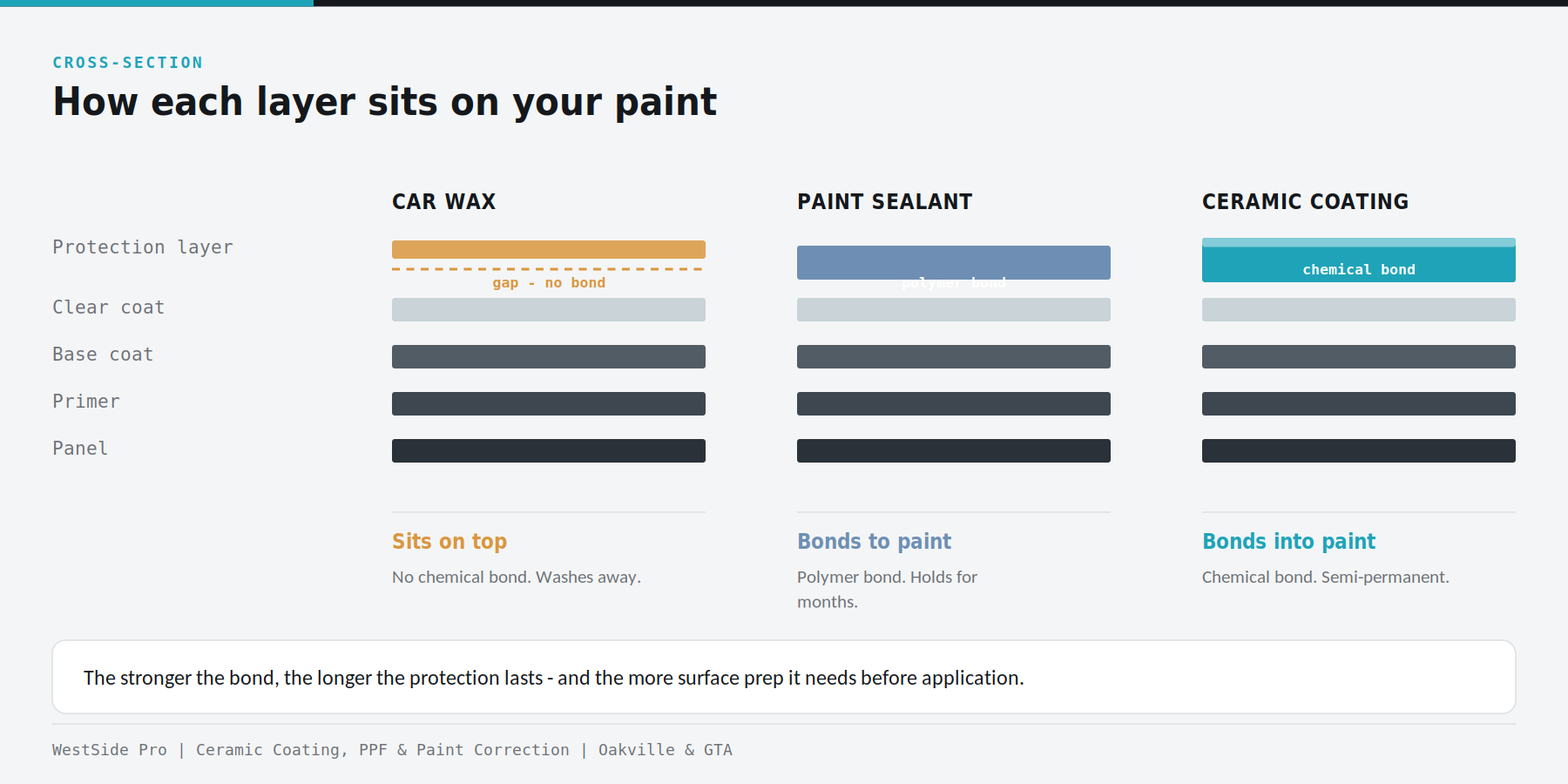
Car wax is either natural (usually carnauba) or synthetic, and it’s applied by hand or machine to leave a warm, glossy finish. It sits on top of your clear coat rather than bonding into it, forming a light sacrificial layer that shields against rain, dust, and everyday sun exposure.
That light bond is also its limitation. Wax typically lasts a few weeks to a couple of months before it washes away, and hot summers or frequent car washes shorten that further. Drivers who love the ritual of detailing tend to stick with wax for exactly that reason it rewards regular hands-on care with a finish that looks freshly done every time.
Paint Sealant
A paint sealant is a synthetic polymer engineered to bond to your paint far more effectively than wax does. That stronger bond creates a tougher protective layer that holds up for several months instead of several weeks, and it resists UV rays, harsh detergents, and changing weather noticeably better.
In the wax vs paint sealant comparison, sealant usually wins on durability and gloss retention, while wax wins on warmth of finish. Sealants sit in the middle of the range longer-lasting than wax, but still simple enough to apply at home without professional paint prep. For many owners, that balance is the practical sweet spot.
Ceramic Coating
Ceramic coating is a liquid polymer built from nano-ceramic particles that chemically bonds with your car’s paint. Once cured, it forms a hard, glass-like layer that is genuinely part of the surface rather than sitting loosely on top of it.
That layer is hydrophobic, so water and dirt bead up and roll off instead of clinging. It resists UV damage, chemical etching from bird droppings and tree sap, and light swirl marks from washing. Unlike wax or sealant, a ceramic coating is semi-permanent properly applied and maintained, it lasts years rather than months. The trade-off is preparation: the paint must be decontaminated and usually corrected first, which is why professional application delivers dramatically better results than a DIY bottle.
Car Wax vs Sealant vs Ceramic Coating: Side-by-Side Comparison
Here’s how the three stack up across the factors that actually affect your decision.
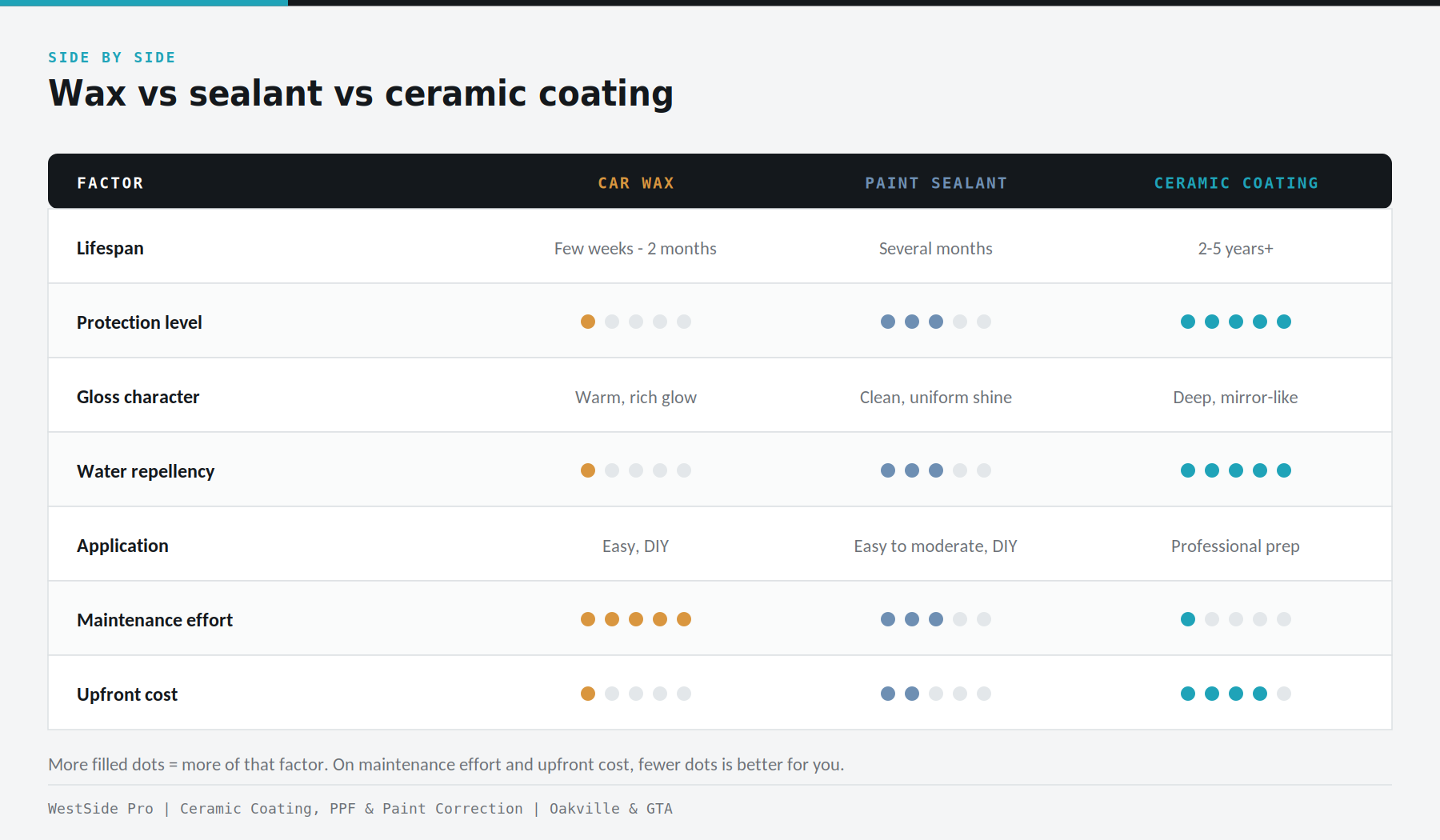
| Factor | Car Wax | Paint Sealant | Ceramic Coating |
|---|---|---|---|
| Lifespan | Few weeks – 2 months | Several months | 2–5 years+ |
| Protection level | Basic | Moderate | Highest |
| Gloss character | Warm, rich glow | Clean, uniform shine | Deep, mirror-like reflection |
| Water repellency | Minimal | Moderate | Strong hydrophobic beading |
| Application | Easy, DIY-friendly | Easy to moderate, DIY-friendly | Professional prep and application |
| Maintenance effort | High (frequent reapplication) | Moderate | Low (correct washing routine) |
| Upfront cost | Low | Low to moderate | Higher |
The table shows what you get. The sections below explain why those differences exist which is where most buying decisions are actually made.
Durability and Longevity: How Long Each One Lasts
Longevity is the single biggest separator between these three products, and it comes down to how each one attaches to your paint.
Wax sits on the surface, so rain, sunlight, and routine washes strip it away within a few weeks to a couple of months. A quality paint sealant bonds more firmly and holds for several months. A professionally applied ceramic coating chemically bonds to the clear coat and can last two to five years or more with proper care.
Ontario weather makes this gap wider than the numbers suggest. Road salt, slush, freeze-thaw cycles, and winter wash frequency all attack a protective layer, and wax simply doesn’t survive that season intact. That’s why ceramic coating vs wax longevity is such a decisive factor for GTA drivers; one professional application can carry you through several winters instead of a reapplication every few weekends.
One honest caveat: a ceramic coating is not “set and forget.” It still needs correct washing to keep performing at its best, and neglect will shorten its usable life.
Protection: What Each Layer Actually Blocks
Protection isn’t a single quality it’s performance against several different threats:
- UV rays and oxidation: Ceramic coating offers the strongest defence, sealant is solid, wax is the weakest and fades fastest under summer sun.
- Bird droppings and tree sap: Both are acidic and can etch a clear coat within hours. A coating’s hard surface buys you far more time to remove them safely.
- Road grime and salt: Ceramic’s hydrophobic surface stops contaminants from bonding, so dirt releases with far less agitation.
- Detergents and chemicals: Sealant resists harsh soaps well; wax breaks down quickly under them.
- Light swirls and wash marks: A coating adds meaningful resistance to minor scratching. Wax and sealant add almost none.
It’s worth being clear about one thing: ceramic coating is scratch-resistant, not scratch-proof. It won’t stop rock chips or a shopping cart. For genuine impact protection, paint protection film is the correct product, and it’s often paired with a coating on top.
Gloss and Appearance: The Look You Get
All three improve how your paint looks; they just do it with different personalities.
Wax delivers a warm, deep glow that flatters darker paint and classic finishes, which is exactly why show-car owners still swear by carnauba. Sealant produces a cleaner, more uniform gloss with sharper reflections and holds that appearance far longer than wax does.
Ceramic coating gives the most dramatic result: a deep, wet, mirror-like reflection with real visual depth. More importantly, it keeps that look with routine washing rather than repeated reapplication. If the paint has swirls or oxidation underneath, however, no product hides them; paint correction before coating is what unlocks the full effect.
Maintenance: What Each One Asks of You
The right choice often has less to do with the product and more to do with how much upkeep you’re realistically willing to do.
Wax needs reapplication roughly every four to eight weeks to stay effective. Skip it and you’re left with unprotected paint without noticing.
Sealant needs topping up every four to six months, which suits owners who want protection handled two or three times a year.
Ceramic coating needs the least frequent attention but the most correct attention: pH-neutral shampoo, two-bucket washing or touchless methods, and avoiding automatic brush washes that inflict swirls. An occasional decontamination and a maintenance topper keep the hydrophobics performing. Full details are in our guide to ceramic coating aftercare.
Cost: Upfront Price vs Long-Term Value
Wax has the lowest entry cost, which is a genuine advantage if you’re protecting a car on a tight budget. Sealant costs a little more but delivers a much better protection-per-dollar ratio because it lasts several times longer.
Ceramic coating carries the highest upfront cost, and that’s where most drivers hesitate. The useful way to look at it is over three years. In that window, wax may need reapplication eight to twelve times every bottle, applicator, and weekend afternoon included. A single professional coating covers the same period with a stronger layer, better gloss retention, and less time spent maintaining it.
There’s a resale angle too: a car with well-preserved paint and no oxidation simply presents better and holds value more effectively than one that’s been through three summers of neglected clear coat.
When Wax or Sealant Still Make Sense
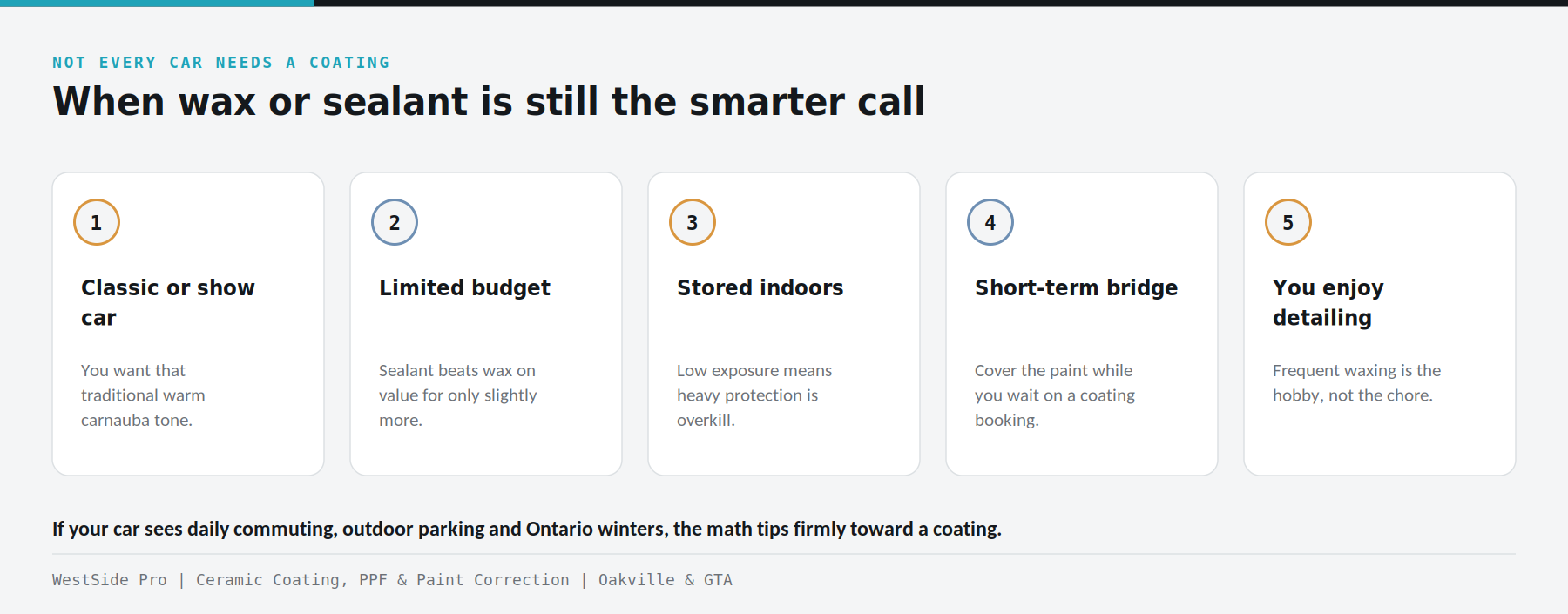
Not every vehicle needs a ceramic coating, and it’s worth saying so plainly. Wax or sealant is often the smarter call when:
- You drive a classic or show car and want that traditional warm carnauba tone.
- Your budget is limited; sealant delivers far better value than wax while costing only slightly more.
- The car is stored indoors or rarely driven, so exposure is low and heavy protection is overkill.
- You need a short-term bridge while waiting on a paint correction or coating appointment.
- You enjoy detailing and consider frequent waxing part of the hobby rather than a chore.
If your car sees daily commuting, outdoor parking, and Ontario winters, though, the math tips firmly toward a coating.
How to Choose the Right Paint Protection for Your Car
Work through these five questions before you decide:
- How long do you want the protection to last weeks, months, or years?
- Where does the car live? Outdoor parking, salt, and full-sun exposure demand more than a garage-kept weekend car.
- What’s your lowest upfront cost, or lowest cost across three years?
- How much prep and maintenance are you willing to do yourself?
- Do you also want impact protection, or are you covering UV, chemicals, and gloss only?
If you answered “years,” “outdoor,” and “minimal upkeep,” ceramic coating is your answer. If you answered “months,” “garage-kept,” and “I enjoy doing it myself,” a quality sealant will serve you well.
Can You Layer Ceramic Coating with PPF or Wax?
This is where a lot of drivers get it wrong, so here’s the short version.
Over wax or sealant: no. A ceramic coating must bond directly to the clear coat. Any wax or sealant residue blocks that bond, and the coating will fail early or cure unevenly. The surface has to be fully stripped, decontaminated, and usually corrected first which is exactly why professional prep matters so much.
Over paint protection film: yes, and it’s recommended. PPF handles rock chips and physical impact, while a coating applied on top adds hydrophobics, UV resistance, and easier cleaning to the film itself. Many owners run PPF on high-impact panels, front bumper, hood, and mirrors with a coating across the full vehicle.
Professional Ceramic Coating in Oakville and the GTA
Choosing the right product is half the job; correct preparation and application is the other half. A coating applied over contaminated or swirled paint locks those flaws in for years.
At WestSide Pro, we specialise in professional ceramic coating, paint protection film, paint correction, and window tinting for drivers across Oakville and the wider GTA. Every coating starts with a full decontamination and paint assessment, so what gets sealed in is a finish worth protecting.
Explore our professional ceramic coating options, or request a quote and we’ll recommend the right level of protection for your vehicle and how you drive it.
FAQs
What is the difference between wax and sealant?
Wax is a natural or synthetic surface layer that gives a warm shine and lasts a few weeks to two months. A paint sealant is a synthetic polymer that bonds more firmly, lasts several months, and holds gloss and UV resistance far longer.
Which is better, wax or ceramic coating?
Ceramic coating is better on durability, chemical resistance, UV protection, and water repellency, lasting years instead of weeks. Wax wins only on low upfront cost and that warm traditional glow. For daily drivers, coating is the stronger investment.
How long does ceramic coating last compared to wax?
Wax typically lasts a few weeks to two months, sealants last several months, and a professionally applied ceramic coating lasts two to five years or more with correct maintenance.
Can I apply ceramic coating over wax or sealant?
No. Any wax or sealant must be completely removed first, along with a full decontamination and usually paint correction. Leftover residue prevents the coating from bonding properly and causes premature failure.
Is sealant better than wax for durability?
Yes. Sealants outperform wax on durability, gloss retention, and resistance to detergents and contaminants, though they still don’t match the multi-year lifespan of a ceramic coating.
Does ceramic coating prevent scratches and rock chips?
It resists light swirls and wash marks, but it will not stop rock chips or deeper scratches. For genuine impact protection, paint protection film is the right choice, often with a coating applied over it.
Do I still need to wash a ceramic-coated car?
Yes. Coatings make washing easier, not unnecessary. Use pH-neutral shampoo, avoid automatic brush washes, and wash regularly to keep the hydrophobic performance strong.