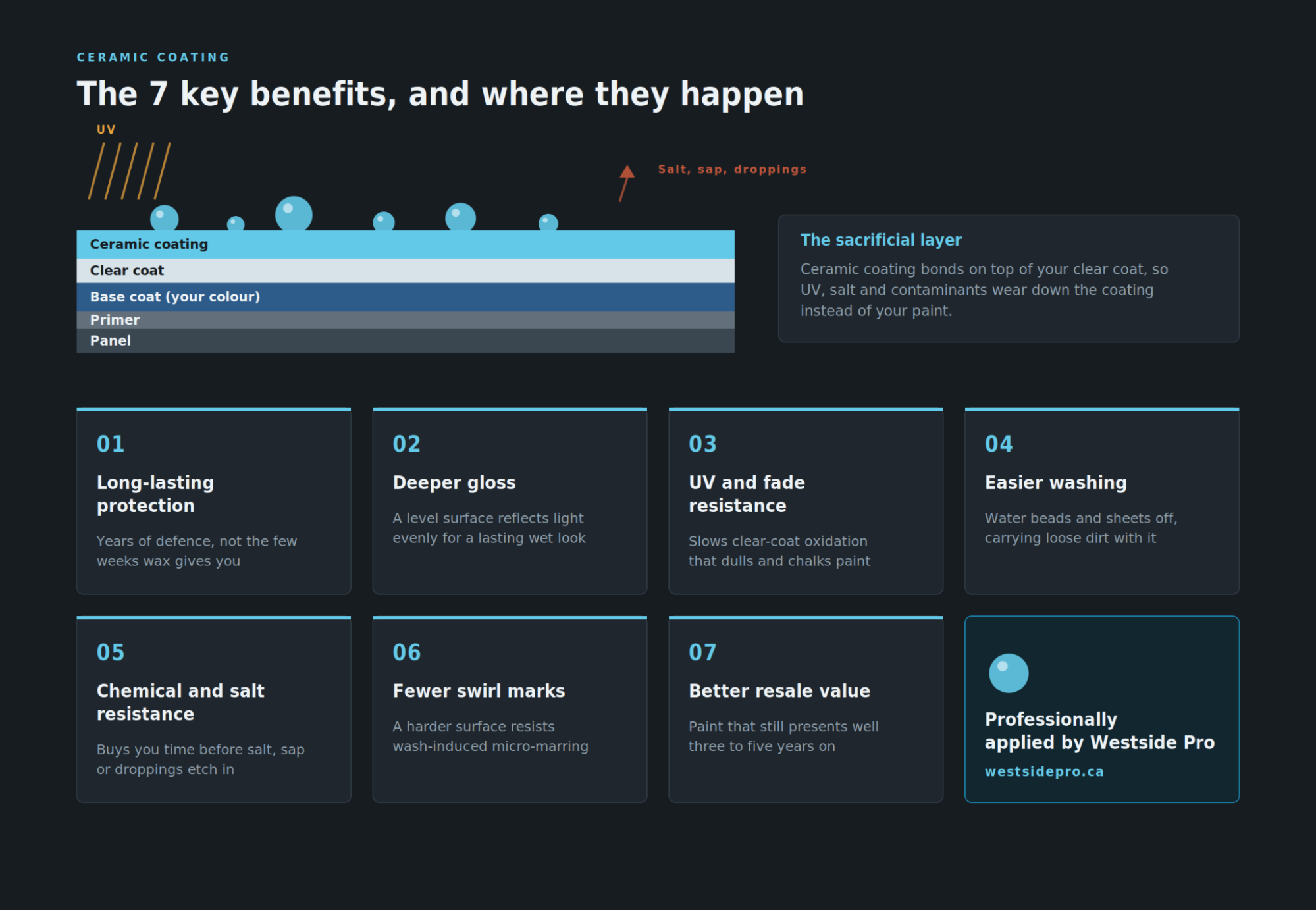
The main benefits of ceramic coating are long-lasting paint protection, deeper gloss, UV and fade resistance, a hydrophobic surface that makes washing easier, resistance to chemicals and road salt, fewer swirl marks, and stronger resale value. It bonds to your clear coat and takes the environmental abuse your paint would otherwise absorb.
If you drive daily through city traffic, park outdoors, or want to keep a new vehicle looking new, ceramic coating does things that wax and sealants simply cannot. Below is what each benefit actually delivers, how long a coating lasts, what it costs you in effort versus money, and where it fits alongside options like paint protection film.
What Is Ceramic Coating?
Ceramic coating is a liquid polymer, usually built around silica (SiO2), that is applied by hand to your vehicle’s clear coat and then cured into a hard, transparent layer. Unlike wax, which sits on top of the paint and washes away, a ceramic coating chemically bonds to the surface and becomes part of it.
The easiest way to think about it is as a sacrificial layer. Bird droppings, salt, UV rays and light abrasion hit the coating instead of your paint. When the coating eventually wears down, it is the coating that has been consumed, not your clear coat.
Because the coating locks in whatever surface is underneath it, application always follows preparation: a decontamination wash, clay treatment, iron removal, and paint correction where needed. Coating over swirls just seals the swirls in.
The 7 Key Benefits of Ceramic Coating
1. Long-Lasting Paint Protection That Outlasts Wax
A traditional carnauba wax gives you a few weeks of protection. A synthetic sealant might stretch to a few months. A professionally applied ceramic coating is measured in years, because it forms a semi-permanent bond with the clear coat rather than resting on top of it.
That durability changes how you look after your car. Instead of reapplying protection every season and hoping you timed it right, you have a continuous barrier against contaminants, UV exposure and light abrasion. Paint oxidation slows down, colour stays truer for longer, and the finish holds its condition instead of gradually dulling.
It is worth being precise about the language, though. Semi-permanent is not permanent. A coating wears down over time and eventually needs to be renewed; it just does so on a timescale of years rather than weeks.
2. Deeper Gloss and a Lasting Wet Look
The most immediately visible benefit is gloss. A coated panel reflects light more evenly, which reads to the eye as depth the so-called wet look that makes dark colours in particular appear richer and more three-dimensional.
The reason is optical. Paint that has been corrected and coated presents a smoother, more uniform surface, so light bounces back cleanly instead of scattering off microscopic swirls and texture. Metallics gain sparkle, blacks gain depth, and the whole finish looks like it was detailed yesterday.
The difference from wax is that this gloss does not fade after a handful of washes. It holds for as long as the coating is intact, with no reapplication cycle to keep up with.
3. UV Protection and Colour Retention
Sunlight is one of the most underrated threats to automotive paint. UV radiation gradually breaks down the resins in your clear coat, and the result is oxidation: a chalky, faded, slightly rough finish that no amount of washing will fix. Reds and blacks show it first and worst.
A ceramic coating acts as a UV filter over that clear coat, slowing the breakdown considerably. Your paint keeps its original colour and depth for longer, and you avoid the point where fade can only be addressed by machine polishing or a repaint.
This matters most if your vehicle lives outside a driveway, a street spot, an uncovered lot at work. Those vehicles accumulate far more UV exposure than garaged cars, and they benefit correspondingly more.
4. Hydrophobic Surface Makes Cleaning Easier
Ceramic coating makes paint extremely slick, and water responds accordingly. Instead of spreading into a film, it pulls into tight beads and sheets straight off the panel and those beads carry loose dirt and dust with them as they go.
That hydrophobic behaviour has two practical effects. Less grime bonds to the surface in the first place, and what does bond releases with far less agitation. Washes get shorter, you need less pressure and less product, and water spotting is reduced because water leaves the surface rather than sitting on it and evaporating.
To be clear, a coated car still needs washing. What changes is that a job that used to take an afternoon and a lot of scrubbing becomes a quick, low-effort maintenance wash which in turn means you are more likely to actually do it.
5. Resistance to Chemicals, Road Salt and Environmental Fallout
Paint faces a long list of chemical attackers: bird droppings, tree sap, bug splatter, industrial fallout, airborne iron deposits, and through a Canadian winter, road salt and liquid brine.
The damage these cause is called etching. Acidic contaminants sit on the surface, react with the clear coat, and eat a permanent mark into it. Bird droppings baking on a hot panel can etch in a matter of hours.
A ceramic coating gives you a resistant barrier and, just as importantly, time. Contaminants struggle to bond to the slick surface, they wipe away far more easily, and the coating absorbs the chemical attack before it reaches your paint. During winter, when salt and brine coat every panel of every vehicle on the road, that barrier is doing the most work of the entire year.
6. Fewer Swirl Marks and Light Scratches
Let us be accurate about this one first: ceramic coating does not make your car scratch-proof. Anything that would gouge your paint will still gouge coated paint, and no coating stops a stone chip on the highway.
What it does do is add hardness at the surface, which meaningfully reduces the fine swirls and micro-marring that make paint look tired. Most of that damage is self-inflicted automated brush car washes, a dropped or dirty wash mitt, drying with the wrong towel, a tree branch dragging along a fender in a tight driveway.
A coated surface resists that class of light abrasion better, and because it is slicker, there is less friction during washing to create it in the first place. If your paint already carries swirls, paint correction before coating is what removes them; the coating then helps keep them from coming back.
7. Better Resale and Trade-In Value
Paint condition is one of the first things a buyer or an appraiser assesses, usually before they check anything mechanical. A finish with strong gloss, even colour and no visible swirling signals a vehicle that has been cared for.
Because ceramic coating slows fade, oxidation and light abrasion, a coated vehicle tends to present noticeably better after three, four or five years than an uncoated equivalent. That helps you hold your asking price in a private sale and strengthens your position at trade-in.
It is a supporting factor rather than a guarantee no coating overcomes high mileage or a poor service history. But when two similar vehicles sit side by side, the one with the better paint is the one that sells first.
Ceramic Coating vs Wax vs Sealant vs Paint Protection Film
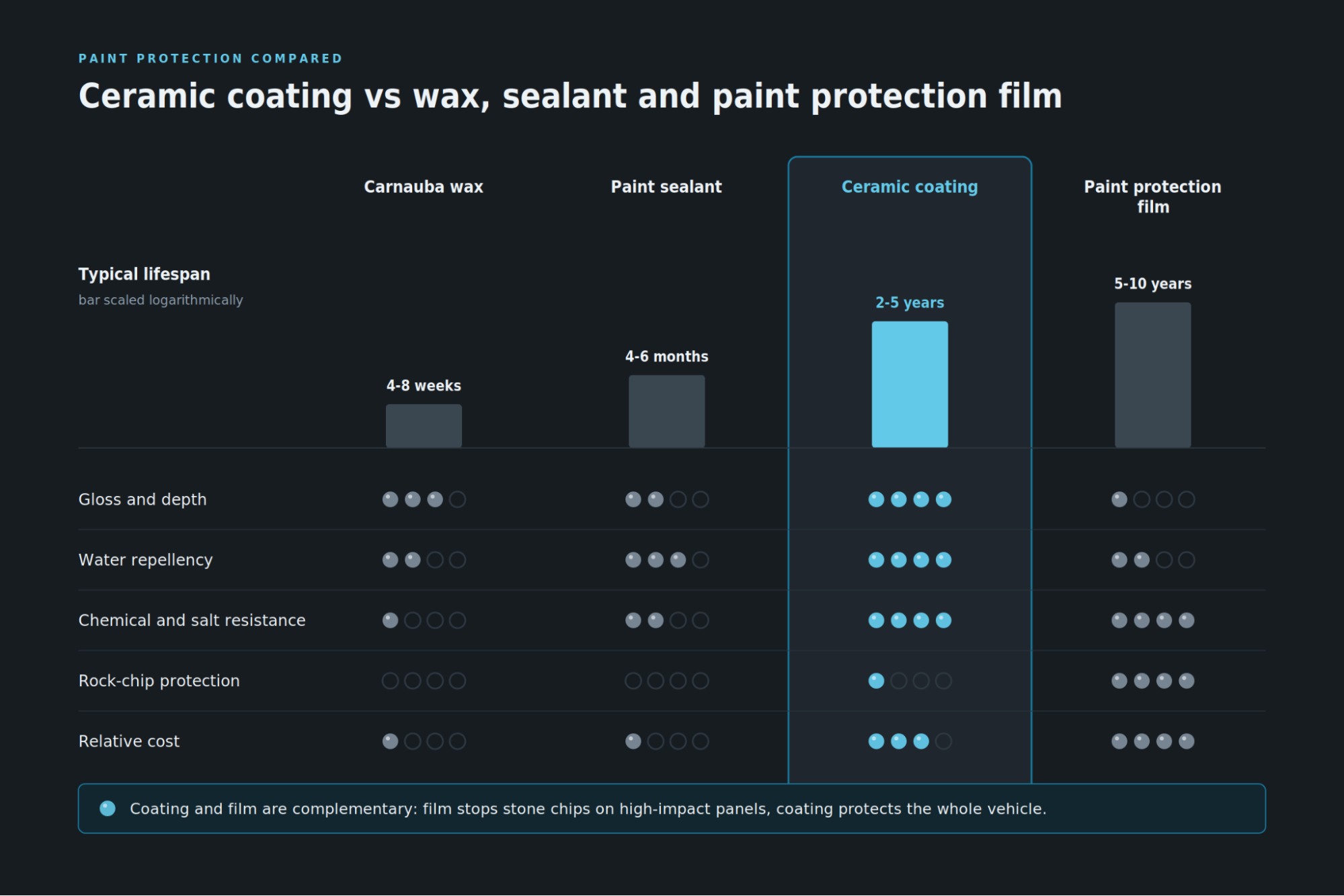
Each of these products solves a different problem, and comparing them on a single axis is where most people go wrong.
Carnauba Wax | Paint Sealant | Ceramic Coating | Paint Protection Film | |
|---|---|---|---|---|
Typical lifespan | 4–8 weeks | 4–6 months | 2–5 years | 5–10 years |
Gloss | Warm, rich | Moderate | Deep, glass-like | Clear, minimal change |
Water repellency | Low | Moderate | High | Moderate |
Chemical / salt resistance | Low | Moderate | High | High |
Rock-chip protection | None | None | Minimal | Strong |
The headline takeaway on ceramic coating vs wax is straightforward: wax gives you short-term warmth and shine, while a coating gives you years of chemical and UV defence with better hydrophobics.
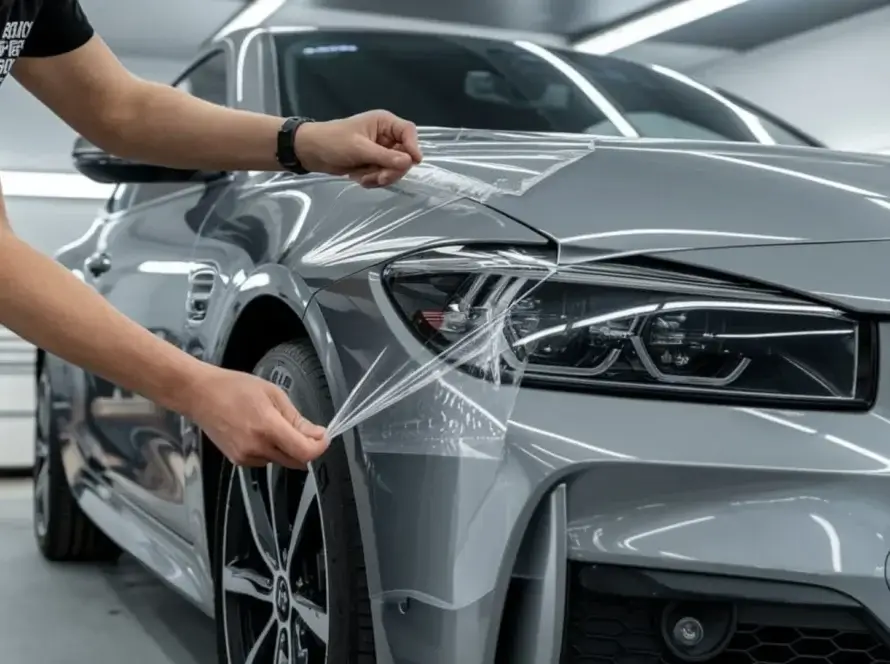
Paint protection film is a different category altogether. It is a thick urethane layer that physically absorbs impact, so it is what stops stone chips something no coating can do. The two are complementary rather than competing. A common setup is paint protection film on high-impact areas such as the front bumper, hood and mirrors, with ceramic coating over the entire vehicle for gloss, salt resistance and easier washing.
How Long Does Ceramic Coating Last?
A professionally applied ceramic coating typically lasts two to five years, and premium multi-layer systems can go longer. That range is wide because durability depends far more on circumstances than on the bottle.
The main variables:
- Product grade and layer count professional-grade coatings and multiple layers outlast single-layer consumer products.
- Preparation quality a coating bonds properly only to a fully decontaminated, corrected surface.
- Where the vehicle is stored garaged vehicles hold their coating much longer than street-parked ones.
- Wash habits pH-neutral shampoo and hand washing preserve the coating; automated brush washes and harsh degreasers strip it early.
- Climate and mileage, heavy winter salt exposure and high annual kilometres both shorten coating life.
Expect performance to taper gradually rather than stop suddenly. The usual first sign is water beading less crisply than it used to, which is your cue to book an inspection.
Is Ceramic Coating Worth the Cost?
Ceramic coating carries a higher upfront cost than wax, so the honest way to assess it is cost per year alongside what you get back in time and paint condition.
Spread a coating across three to five years and compare it against repeated waxing over the same period, plus the hours spent applying it and the longer washes an unprotected car demands. Then add the cost you avoid at the other end: correcting UV fade, polishing out etch marks from salt or bird droppings, or accepting a lower trade-in on dull paint. For most people who keep a vehicle for several years, the arithmetic works.
There are cases where it does not. If you are selling the car within a few months, the timeline is too short to recover the investment. If your paint needs substantial correction first, budget for that work honestly coating over damaged paint locks the damage in and wastes the coating. And if your vehicle is garaged, rarely driven and already immaculate, wax may be enough.
Coating is a long-term play. It rewards owners who intend to keep the vehicle and maintain it.
Professional Application vs DIY Ceramic Coating Kits
Consumer coating kits are widely available, and the product in them is often decent. The outcome gap between DIY and professional work is almost entirely down to preparation and application control, not the bottle.
Professional application is a sequence: decontamination wash, clay treatment, iron and tar removal, machine paint correction where required, a panel wipe to strip residual oils, then coating applied panel by panel in a controlled environment with the right temperature, humidity and lighting, and a proper cure period.
The common DIY failures follow directly from skipping parts of that sequence. High spots and streaking appear when excess product is not levelled within the flash window. Swirls and water spots get permanently sealed under the coating because the paint was never corrected. Uneven curing happens when the car is coated outdoors, in the sun, or driven too soon.
The catch is that these mistakes are not easy to undo. Correcting a badly applied coating usually means machine polishing it off entirely and starting again, which costs more than having it done properly the first time.
Why Ceramic Coating Makes Sense in Canadian Conditions
Canadian vehicles get squeezed from both directions, which makes coating more valuable here than in milder climates.
Winter brings salt, brine and slush against every painted surface for months, followed by a spring of grit and sand. Summer brings intense UV, tree sap, and bug season on the highway. Very few environments run both extremes back to back the way ours does.
The winter half is where a coating earns its keep in a way people underestimate. Most drivers wash less often in the cold, precisely when salt is doing the most damage. A hydrophobic coated surface holds less salt film, releases what it does hold with a quick rinse, and stays protected through the stretch where an uncoated car is quietly accumulating corrosion risk. If you are considering ceramic coating in Mississauga or elsewhere in the GTA, the pre-winter window is the smartest time to book.
How to Maintain a Ceramic-Coated Car
Coating reduces maintenance; it does not eliminate it. A short routine keeps it performing for its full lifespan:
- Wash every two weeks with a pH-neutral car shampoo.
- Use the two-bucket method with a clean microfibre mitt.
- Skip automated brush washes touchless is fine if you must.
- Never wash in direct sunlight or on hot panels.
- Remove bird droppings, sap and bug residue as soon as you notice them.
- Apply a compatible ceramic topper periodically to refresh hydrophobics.
For the full routine, including the first-week cure rules and what to avoid in winter, see our guide to ceramic coating aftercare.
Protect Your Paint with Westside Pro
At Westside Pro, ceramic coating starts with an inspection of your actual paint, not a package upsell. We assess the condition of your clear coat, carry out the decontamination and correction the surface needs, and recommend a coating and layer count based on how and where you drive.
Book a paint assessment and we will show you exactly what your finish needs and what a coating will do for it.
Frequently Asked Questions
What does ceramic coating actually do for a car?
It bonds a hard, transparent silica layer to your clear coat that resists UV rays, chemicals, road salt and light abrasion. Your paint stays glossier and truer in colour for longer, and the slick surface makes washing significantly faster and easier.
How long does ceramic coating last?
A professional coating generally lasts two to five years, and longer with premium multi-layer systems. Actual lifespan depends on preparation quality, where the vehicle is parked, wash habits, mileage and winter salt exposure.
Does ceramic coating prevent scratches?
No. It reduces fine swirl marks and light micro-marring by adding surface hardness, but it will not stop deeper scratches or stone chips. For genuine impact protection you need paint protection film on the affected panels.
Do I still need to wash a ceramic-coated car?
Yes, and washing regularly is what keeps the coating working. The difference is effort: the hydrophobic surface releases dirt easily, so a maintenance wash is quick and needs no aggressive scrubbing or strong chemicals.
Can ceramic coating be applied to a used car?
Yes, but the paint needs assessment first. Used vehicles usually carry swirls, oxidation or etching, and a coating locks in whatever is underneath it, so paint correction beforehand is what determines the final result.
Does ceramic coating protect against road salt?
It does. The coating resists salt and brine chemically and prevents them from bonding tightly to the paint, so they rinse off with far less effort which is exactly what you want during a Canadian winter.
Can I apply ceramic coating myself?
You can, but results depend on preparation and application control more than on the product. High spots, streaking and coating sealed over existing swirls are common DIY outcomes, and fixing them means polishing the coating off completely.
Should I choose ceramic coating or paint protection film?
They solve different problems, so the answer is often both. Ceramic coating delivers gloss, UV protection and easy cleaning across the whole vehicle; paint protection film absorbs stone chips on high-impact panels like the bumper and hood.